Showing posts with label ppd. Show all posts

Thursday, 1 December 2011

PPD Assignment 2:5. Literature Reviews

As the first assignment on this Personal and Professional Development course we wrote a literature review. This was something I'd never done before, and found quite a challenge.

The highest hurdle to get over, and, in retrospect, one of the strengths of a formal literature review was to narrow the source material down enough to fit the given limits. A literature review where you cover only a small part of all available literature can give you a quick yet in-depth understanding of the subject matter - provided you've picked the right source material!

Our little review wasn't anywhere near a real scientific literature review, but I feel better equipped to researching and writing something on a narrower topic and delving deeper (old adage: as you progress in academia, you know more and more about less and less - with the obvious pinnacle...) into a subject more directly related to horticulture. Or possibly even just for my own edification!

The internet is rife with resources for conducting literature reviews. University of Toronto has an excellent handout with tips. The Wikipedia article on literature reviews has a plethora of links for further information on the subject, and I think I may already have fallen in love[1] with this, a website from University of Reading, specifically designed to help science undergrads on getting started with doing scientific research. 

...and for anyone who can't be bothered to read long explanations, here's a tweet with all the steps for writing the perfect literature review:

Mihaela (Dr. V)
lit review steps 1: find articles; 2 read them, use them to 3 find more articles; 4 organize all articles; 5 outline; 6 write


[1] It turns out I'm still a scientist at heart, despite my predilection for getting down and dirty with plants and soil...

Image source: http://www.psichi.org/images/site_pages/13_2_lai_1.jpg, tweet source: http://prprofmv.wordpress.com/2011/03/16/literature-review-process-update-1/

Wednesday, 30 November 2011

PPD Assignment 2:4. Effective presentations


At this day and age, nearly everyone can expect to have an opportunity to give a presentation at some point of their professional lives, either within their workplace, or to a potential customer.

When it comes to giving a presentation, preparation is everything. Both my own experience and specialist opinion agree on this.

For preparation, one generally should, in the very least, consider the following:


Why are you giving this presentation? What's the result you're looking for?
What exactly are you going to say?
Who are you telling it? What, if anything, do they already know? What are their positions? Are they likely to be interested?
Where will you be presenting? Will all the equipment you'll need be there?
How will you deliver your message? What sort of approach would work with this audience?
Once you've these down, you can start crafting your actual presentation. This is when you need to come up with a logical structure for your presentation. There should always be a clear introduction, then the meat of your subject, and you should always finish with a summary or recap.

It's surprisingly hard to get things like the timing just right, so always, always, practice your presentation a few times. Practice won't just make the presentation better, but it will also make you properly familiar with it and help with any nervousness you might feel. I myself can quite enjoy public speaking, and always the more better prepared I am. This isn't to say I don't get the nerves, but it generally isn't my main worry when doing a presentation.

For those of a more nervous disposition, this teaser video has some useful things to say about nervousness and movement during your presentation:

Image source:http://www.research.ucla.edu/era/present/img002.GIFhttp://www.research.ucla.edu/era/present/sld002.htm

Tuesday, 29 November 2011

PPD Assignment 2:3. Team Building

There is a vast number of theories about how exactly groups and teams develop. We're now going to take a quick look at the "Forming - Storming - Norming - Performing" model of group development, also known as Tuckman's Group Development model, named after its creator Bruce Tuckman.


According to this model, there are four stages in the formation of any team or group of people.


Forming
This is the first stage of the development of a team of people who haven't worked together before. Everyone is nice to everyone, and the team mostly concentrates on getting its routines worked out. Not much is accomplished towards the team's actual goal at this point.

Storming
The second stage isn't named without reason. At this stage the team members have become comfortable enough with each other to express dissent - or just complain. The true purpose and direction of the team are worked out. Some teams never make it out of this stage, and those are not pleasant situations to work in.

Norming
Most teams and groups make it to this stage. Members are comfortable with each other and agree on and work towards their common goal.

Performing
The most high performance teams get to a stage where the members are able to work together seamlessly, without outside supervision. Productivity is very high, and teams at this stage are a real pleasure to be a part of.


However, long-standing teams never remain in the Performing stage. Things like changes in team composition will cause the team to revert back a stage or two, so the in practice the process is a cycle. 

I must say many things make more sense now that I'm actually aware that teams and groups go through this process of development. 

(Image sources: http://theteambuildingexperience.com/images/team_building.jpg, http://www.alchemyformanagers.co.uk/topics/r64ZCZGCF8evQ5Wf.html)

Tuesday, 22 November 2011

PPD Assignment 2:2. VARK Learning Styles

It has long been known that people tend to learn in different ways - one size does most definitely not fit all.

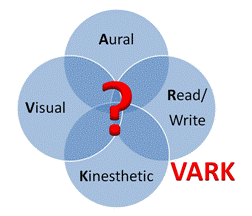
One way for figuring out how you learn best – what kind of a learner you are, if you will – is to use the VARK learning styles approach.

VARK stands for...

V isual
A ural (hearing)
R ead/write
K inesthetic

The model categorises people into these four groups, based on how they're likely to learn best.

For example, visual learners will benefit most from using material with a lot visual content like diagrams, pictures or graphs as well as from highlighting or underlining key text, and using lots of different colours. Aural learners, on the other hand, learn best by listening to the material, so it's essential for them to attend their classes!

Those who fall in the read/write group obviously learn most easily by reading, and by writing things down. Kinesthetic learners, on the other hand, need to physically do the thing they're learning. This makes learning in a traditional school or lecture hall environment a challenge, but this can be overcome by using prodigious amounts of real-life examples.

It's also good to keep in mind that around 60% of people are multimodal learners. This means that they often learn best when they combine the techniques of two or more learning styles. For example, I test as a KVR, and I have indeed noticed that I'm unlikely to remember something that I've only heard, if there isn't something concrete or visual I can connect it to.


(Image sources: diagram, vark aardvark)

PPD Assignment 2:1. Effective note taking


Every student who attends their lectures also usually takes notes. These notes are then carefully filed away, usually until about a week before the exams, at which point the student scrabbles to remember why they wrote down “except on leap years! IMPORTANT!!”
A mind map


The best practice for taking notes effectively involves being engaged with the subject before, during and after each lecture:

Before the lecture:

  • review your notes from the previous lecture
  • switch to a positive mindset towards listening and participating
    • ask yourself: “what’s in this for me?” - even if it turns out just to be “passing my exam”
During the lecture:
  • most importantly: stay alert and don’t get distracted - don’t sit next to that friend who relays his facebook friends’ updates as they happen
  • write things down in your own words; don’t just copy the lecturer’s notes
  • pay special attention to any clues (verbal and non-) to what is especially important
After the lecture:
  • review your notes as soon as possible


There are a large number of different note taking formats, and I gave the Cornell format a try earlier this semester:
It started quite well.
But then I started slipping


 More and more...
...until I'd reverted back
to my usual style. :/


Some other note taking formats are:

...to name but a few (more examples here), so there's a style to suit everyone.

I find mind mapping especially fascinating, but find it difficult to implement at lectures. I’ll keep trying, though!